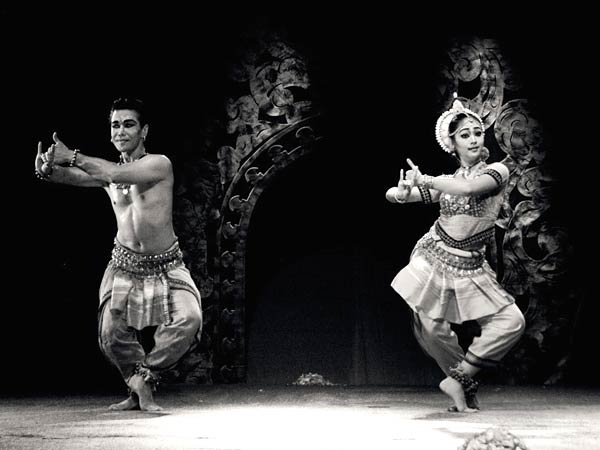
Saturday, October 3, 2015

FORMS OF ODISSI PERFORMED IN RECENT DAYS

The first performance of Odissi Dance outside Orissa was given by Priyambada Mohanty and D.N Pattanaik in the Inter University Youth Festival held in Delhi in 1954. Eminent scholars like Mohan Khokar, Charles Fabri etc got interested in odissi thereafter and the famous art journal MARG brought out a special issue on Odissi Dance in 1960. In the year 1964 in a national seminar and festival held in Hyderabad Odissi received its first recognition as a classical dance system.

DIFFERENT TYPES OF ODISSI DANCE PERFORMED IN RECENT DAYS

1   Mangala charan is an invocatory piece where the dancer evokes the blessings of the lord and the audience.


 Batu nritya is actually an item of pure nritya held in hnour of Bakuta Bhairava, i.e Shiva. The dance is not accompanied by any song but throughout the item a refrain of rhythmic syllables is provided. This refrain is in the form of one-line UKUTA and as this is recited in the tala, different Jati-patterns are improvised and executed with feet.
 Pallavi  is elaboration of both the dance and the accompanying music. In the beginning the accompanying music. In the beginning the acconpaying vocalist sings the raga-murti or the raga-rupa of a particular raga( on which the pallavi music is based). The Sanskrit sloka, taken from orissan texts on music and describing the murti or image of the raga is enacted by the dancer. Then a line of Ukuta is sung basing on the notation of the particular raga. The dancer keeps beating on the feet. Then a number of pure nritya sequences follow. Intermittently different swara patterns and tala patterns are worked out through various movements. Pallavis are known after their ragas on which they are based, some popular pallavis are Basanta, Kalyana, Mohana.

 
Abhinaya is acting- out of the emotions expressed in the accompanying song or lyric. As we have mentioned earlier the astapadis of Jayadeva and Oriya songs from medieval poets of Orissa are sung. These poets mention the raga and sometimes even tala, which must be followed while singing it. This has helped to maintain the pristine purity of age-old style. Odissi music as an accompaniment differs from its solo performance. While in the former the stress is laid on histrionics of Abhinay, in the solo performance, as pointed out in chapter 4, the performer tries to maintain even keel between Ragang, Bhavang and Natyang. 
 
Mokshya Nata accentuates moksha (salvation) in more than one sense. The dancer reminds the audience in this concluding item the ultimate aim of art which is reintegration with the absolute. Form wise it means reintegration and founding up of the main theme and the main bhava. This is an item of pure nritya and is performed in fast tempo. There is no music. Only there is recitation of rhythmic syllables, which are also played out on the mardala. 


Odissi music :- as a cognate of odissi dance

Saranga dev conceived of sangeet as a triad- a harmonious union of song, music and dance. He assigned song the most important place in that triad. Ideally, odissi is also a triadic package of odissi song, odissi music and odissi dance. This triad was known as sampradaya in ancient Orissa. To the non-orissi world, however, odissi conjures up the image of only a dance style called ‘Odissi’. It is difficult to say exactly since what time odissi dance and music, as they are known today came into being. But it is a well-known fact that odissi dance and music in their present formal structure came into existence through the devdasis of Jagannath temple at Puri.

These devdasis were also known as Devaganikas (the prostitues in the service of the Devas). But the Devdasis of Puri were more popularly known as Maharis. The devadasis are divided into two types, namely, Bhitara Gaauni and Samprada Nijoga. Though the works are divided among them, the natures of work do not differ much. They sing mangala gana during various auspicious functions in the temple or in the palace.
     When Krishna janma is dramatized in the temple, the devdasis play the role of Yasoda and rohini and Breast-feed Krishna. In some festivals the dance accompanies song, in some there is only dance and music and no song. The Devdasis dance and sing during the following festivals: - Damanaka Chaturdasi, Dola, Pushyaviseka, Rath yatra, Snan yatra. There are several forms of practices of dance forms which were practiced after the Ganga dynasty was established in Orissa in the 11th-12th century A.D.


Pre-ganga Practices
1.      Hera Panchami: - in this festival the devadasis invite the daitapatis (a section of the priests) and accompany goddess laxmi.

2.     Niladri Bije Festival: - there is quarrel between Laxmi And Narayan. In the polemics arising out of that Quarrel, the devasis argue on behalf of Laxmi.

3.     Sakala Dhupa: - this is breakfast time od lord Jagannath. The devdasis dance near the Garuda Pillar.

4.     Chandan jatra: - the devdasis sing near the Kalaghat door.

5.     Sola puja: - during this festival or ritual the devdasis dance in the precinct of goddess Vimala’s temple.

These five sevas are known as Angila practices. These were there before the Ganga kings introduced some more practices in the following manner:

Post Ganga practices
1.     Rukmini Parinaya Festival: the festival to commemorate the marriage of rukmini to the lord, it is done in south indian style and the devdasis are employed to sing the mangala gana (auspicious songs) in this devine marriage festival.
2.     The practice of singing mangala gana during various auspicious festivals in the king’s palace.
3.     The practice of devdasis dancing on the chapa (boat-riding of the lord) during the Chandan Festival.

Needless to say that here nritya includes also song and music. Thus from ancient times the whole triad of Odissi Sangeet is considered bhava-pradhan (emotion-centered, or emotive) conforming to the conditions laid down in the sastras for margi nritya or daivi nritya mahari devdasi dance can be classified as margi. Besides though it is loosely called nritya, odissi dance as we have observed earlier, includes nritta (dance without song or acting) nritya (dance with song and music) and natya (acting or abhinay with songs).
Perhaps till 12th century A.D. Odissi dance was performed only as nritta. It was king Narasingha Deva 2 (1278-1307 A.D) who introduced singing of Gitagovindam authored by poet Jayadeva in Jagannath temple. A royal declaration in possession of an old Mahari throws light on the various stipulations which governed the duties of the maharis in former times. It says …... At the time of performance, they are not to look at the the audience. Their dance must strictly follow the shastras. They must dance in the following talas : Pahapata, Sarimana, Parameswara, Malashree, Harachandi, Chandan Jhoola, Shreemangala, Bachanika and Jhuti Atha-tali, they are to preform bhava only from the Geeta Govindam.
To keep the purity of the dance, song music intact great caution is taken. Every day during the first puja service the devdasi dances in the jagamohana (the entrance room to the sanctum). Behind her sit the mardala player and the brass manjira player behind them stands the minanahaka, the dance teacher.It was in the 16th century that this classical dance form was gradually extricated from its ritualistic function and started being used for secular entertainment of royal audience. King prataparudravera (1497-1538 A.D) according to a stone inscription inscribed on the jayvijay gate of the Jagannath Temple, made a proclamation that no other song except Gitagovindam would be sing in the temple. 
When odissi dance started being performed outside jagannath temple, devadasis were not always available. In fact without a fiat from the Puri ruler they were not allowed to perform everywhere. The society was so orthodox that neither the family nor the society permitted girls to dance in public places. That is why women were made to dance in the temple, the system was legitimized by calling the girls ‘wives of the gods’. So also performance for the kings by girls was legitimised by the fact that the kings were ‘gods on earth’. 
But girls performing for the public were taboo. So Batu or manabhaka that is man in woman’s disguise used to dance in the past for the entertainment of the public. Boys performing odissi dance in the guise of women were locally known as Gotipua. Originally the practice of women performing classical dance in the guise of women was derided and was considered to be Tamasi Nritya. 


here are the following links of youtube 

Friday, September 25, 2015

ORIGIN AND A SHORT OVERVIEW ON ODISSI DANCE

The lyrical, sensuous classical dance style, known as Odissi today, belongs to the eastern part of the country, and is referred to in the Natya Shastra Odra- Magadhi. It is characterized by undulating torso movements and gait which transform seamlessly verifying patterns that are typical of the region's culture. Odissi traces its roots at least to the 2nd century BC, through archeological and textual evidence. Although it existed in the some form or the other through the centuries, it is difficult to say exactly what form it took post-independence in 1947.

At the time of its reconstruction, this style that is known as odissi today, sought its roots in the living dance tradition of the Gotipus (boy dancers) as well as the almost extinct Mahari (temple devadasis) tradition. Insightful gurus and the scholars also found the Orissa’s sculptural legacy (particularly within the temples) to be a major resource for devising the movements and positions to be used in dance. In Orissa, people with a talent for dance normally found an outlet in popular Oriya theatre before odissi emerged as an independent form. Most of the girls pursuing dance at that time learnt other styles like Bharatanatyam, Kathak, or even Uday Sankar style. 
  
After the 1950’s, odissi was established as a new style in the classical field. Priyambada mohanty and Indrani Rahman were able to arouse initial curiosity in the 1690’s while Sanjukta Panigrahi, Kumkum Das, Sonal Mansingh and some others brought about a serious interest in the 1970’s and 1980’s when it became immensely popular. Ground-breaking work was done by the senior gurus in terms of structuring the form and creating new pieces. A lot of established dancers of other styles were attracted by Odissi and chose to add an item or two to their repertoire. Dedicated exponents of odissi presented full-length performances were held initially.

Gurus like Mayadhar Raut and Hare Krishna Behara settled and taught in Delhi, while guru Shankar Behara to Mumbai and Muralidhar Majhi to Kolkata, to start Odissi classes. In Orissa institutes like Kala Vikas Kendra, National Music Association and Utkal Sangeet Mahavidyalaya did pioneering work, as a result of which we see today a large number of gurus and dancers within this form. It was in 1985 that Angahar a landmark festival of odissi was organized by the Gandhara Mahavidyalaya, New Delhi. It brought together all major gurus, scholars and exponents of the dance form, including representations from the Gotipuas and Mahari traditions for the first time. This enabled an assessment of the development of this form since its revival. Initially it was the solo format that brought Odissi to the fore. The repertoire of Odissi usually lasted for about two hours.
https://www.youtube.com/watch?v=AQm9vkJawI4
A Mangalacharan and couple of pallavis, the Dashavatara and the detailed presentation of the Ashtapadis formed the core of the presentation. Oriya songs were rarely presented, though many dance-dramas were choreographed in Orissa that had Oriya literary content. This music was a blend of the Hindustani and the Karnataka, but with a typical Oriya flavor; most oriya musicians learnt either the Hindustani or the Karnataka styles. Unfortunately, traditional forms of odissi music like Champu, Chhanda and Janana were rarely presented at music concerts, though this trend has changed recently. There was a lacuna in terms of musical forms available for dance, especially form Nritta (abstract) items. Even the Talas and basic Bols (syllables) had to be culled from unstructured material. Except for lilting Oriya songs which were not necessarily Raga-based, composers had to resort to the Hindustan or Karnatak mode, where the structure of a Raga was required as a base. 


one of the postures of Odissi dance 

Today, three main styles have emerged within Odissi, representing three major gurus that were involved in the restructuring of the form. Gurus Pankaj Charan Das, Deba Prasad Das and Kelucharan Mohapatra. Guru Pankaj Das’ style carries forward maharaja tradition; Guru Deba Prasad Das’ a robust and somewhat rustic feel, while guru Kelucharan Mohapatra, the most prolific and influential of them all, has a very intricate and filigreed treatment both in the abstract and expressional aspects. In the last few years, the principally of the solo format seems to be receding, to be replaced sadly by a plethora of increasingly tableau-like group work. 
Often, full-length solo performances do not have foray even in Orissa; partly due to organizer’s demands for so-called new work. 

This is somewhat disquieting and even alarming to the connoisseur, because our tradition allows for any amount of creativity within its framework. However, this does not detract from some very interesting group choreographies that have emerged from serious dancers and gurus. Many choreographers incorporate Gotipua dancers and Chhau elements to enrich presentations, though one feels that this should be done with discrimination and aesthetics in mind. Fusion attempts with western contemporary have rarely proved successful.

 Attempts at incorporating oriya literature in dance is a welcome and satisfying trend. It is only a few who seek the roots of the form to forge newer directions. The need of the hour is the creation of a discerning and demanding audience including the media, so that a serious work, particularly in the solo format is sustained, and the art evolves into another dimension. It would be a pity if the aspiration for excellence is lost in the jungle of ignorance.